One Side Charred, One Side Weeping: The Toaster's Eternal Bagel Betrayal and Our Pathetic Acceptance of It
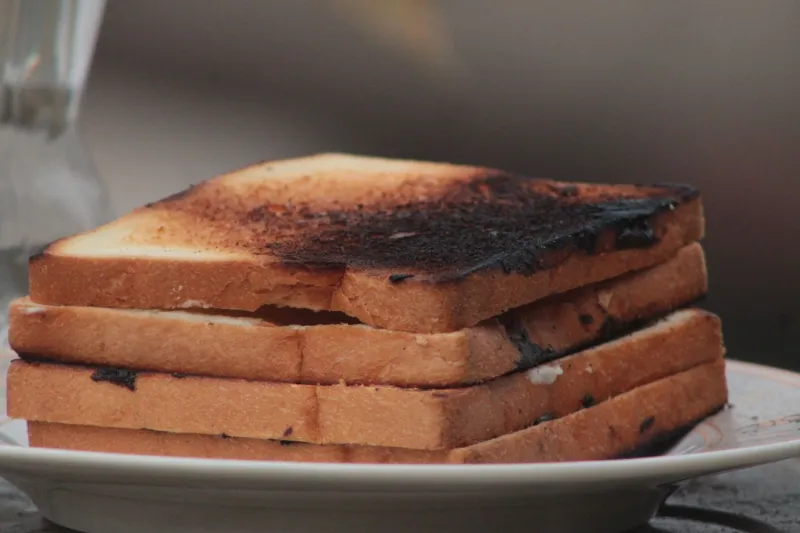
Let's establish the facts. You own a toaster. You bought bagels. You believe, on some deeply irrational level, that this morning will be different — that today the toaster will look at the two halves of your everything bagel and distribute heat with fairness, dignity, and a basic respect for your breakfast experience. It will not. One half will emerge golden, warm, and structurally perfect. The other will be a smoking archaeological artifact that smells like a campfire held inside a crematorium. You will eat both halves anyway. This is your life now.
Welcome to the Great Bagel Betrayal — a culinary injustice so normalized, so thoroughly baked into American morning culture, that we have collectively decided not to talk about it. Until now.
Why the Toaster Is Fundamentally Lying to You
Here's the physics, delivered without mercy: a standard toaster uses heating elements positioned along the sides of each slot. These elements are designed, in theory, for sliced bread — a thin, flat object with roughly uniform density and a reasonable sense of self-awareness about its own dimensions. Bagels are none of these things. A bagel is a thick, doughy torus with a hollow center, a crust that behaves differently from its interior, and the structural confidence of something that knows it's going to win.
When you drop a bagel half into a toaster slot, the heating element on one side sits approximately half a millimeter from the cut face of the bagel. The heating element on the other side is essentially shouting across a canyon at the crust, which is already hardened, already defensive, and deeply uninterested in absorbing more heat. The result is thermodynamic inevitability: one face gets direct, intimate heat contact. The other gets vibes.
Most toasters also have a "bagel setting" — a button so aggressively optimistic it borders on delusion. The bagel setting typically reduces heat to the outer elements while concentrating it on the inner-facing ones. In practice, this means your crust stays soft and your cut face achieves temperatures previously associated with industrial welding. Progress.
A Definitive Ranking of Bagel Toasting Methods by Likelihood of Producing One Perfect Half and One Atrocity
Standard Toaster Slot (Classic Mode): The baseline betrayal. Produces uneven results approximately 94% of the time. The remaining 6% is a statistical anomaly that scientists have not been able to replicate. You will frame that bagel if you achieve it.
Toaster Oven: Theoretically superior. In practice, you'll forget to watch it, get distracted by your phone, and return to something that has transcended the concept of toast entirely. Has entered a new state of matter. Requires a spatula and an apology.
Broiler Setting on Your Oven: Bold. Unhinged. Produces results in approximately 90 seconds if you watch it like a hawk, or a small grease fire if you do not. The broiler has no concept of nuance. It knows only intensity.
Flat Griddle or Skillet: Actually the correct answer, which is why no one does it before 9 a.m. Requires butter, patience, and a level of morning consciousness that most Americans simply cannot access before their first coffee. Produces a uniformly golden, slightly crispy surface. Feels like cheating. Is cheating. Cheat.
Air Fryer: The new frontier. The people who use an air fryer for bagels will tell you about it unprompted, at length, with the evangelical fervor of someone who has discovered a previously unknown religion. They are not wrong, which makes them insufferable.
Microwave: No. We will not be discussing this. You know what you did.
The Psychological Profile of a Person Who Keeps Buying Bagels
Despite knowing — with the certainty of someone who has been disappointed repeatedly since childhood — that the toaster will fail them, Americans purchase approximately 3 billion bagels per year. This is not a typo. This is a portrait of a nation that has made peace with low-grade culinary suffering in exchange for a breakfast item that is, frankly, worth it.
The bagel buyer exists in a state of what psychologists might call "optimistic delusion" and what Pointlesspedia calls "Tuesday." They have internalized the betrayal. They have metabolized the injustice. They have developed a sophisticated coping mechanism that involves eating the good half first, then eating the charred half while staring into the middle distance and thinking about whether they should move somewhere warmer.
Some people — and these are the truly evolved among us — have begun proactively managing the grief. They toast the bagel twice, flipping it between rounds. They pull the lever early on the weaker side and let the stronger side go longer. They have developed bagel toasting protocols that they have not written down but carry in their bodies like muscle memory, like trauma, like both.
The Cream Cheese Compensation Theory
Here is where we must acknowledge the unsung hero of this entire operation: cream cheese. Specifically, the way a thick, cold, generous layer of cream cheese can salvage a cremated bagel half by providing a thermal buffer, a textural contrast, and a psychological distraction significant enough to make you forget, briefly, that you were wronged.
This is not an accident. The bagel-cream cheese industrial complex has understood for decades that the product does not need to be toasted perfectly — it needs to be toasted adequately, with enough structural integrity to hold toppings and enough warmth to soften the cream cheese slightly. The bar is underground. The bagel clears it anyway. This is the arrangement.
Lox helps too. If you're putting lox on it, honestly, you could toast that bagel with a flamethrower and still have a good morning.
A Note on Accountability
Toaster manufacturers have had decades to solve this. Convection technology exists. Precision heating elements exist. The engineering required to toast a bagel evenly is not, by any measure, the most complicated problem facing the appliance industry. And yet, here we are. Every morning. One half perfect, one half carbonized, cream cheese doing the emotional labor.
We are not saying this is a conspiracy. We are simply noting that it is suspicious, that it has continued for an unreasonable amount of time, and that the bagel setting button on your toaster is the most ambitious piece of fiction printed on any kitchen appliance since someone decided to put a "self-cleaning" label on an oven.
Toast your bagels in a skillet. Use butter. Accept that this is the way. The toaster had its chance.