USB Cables: A Monument to Human Stubbornness and Our Eternal Inability to Plug Things In Correctly
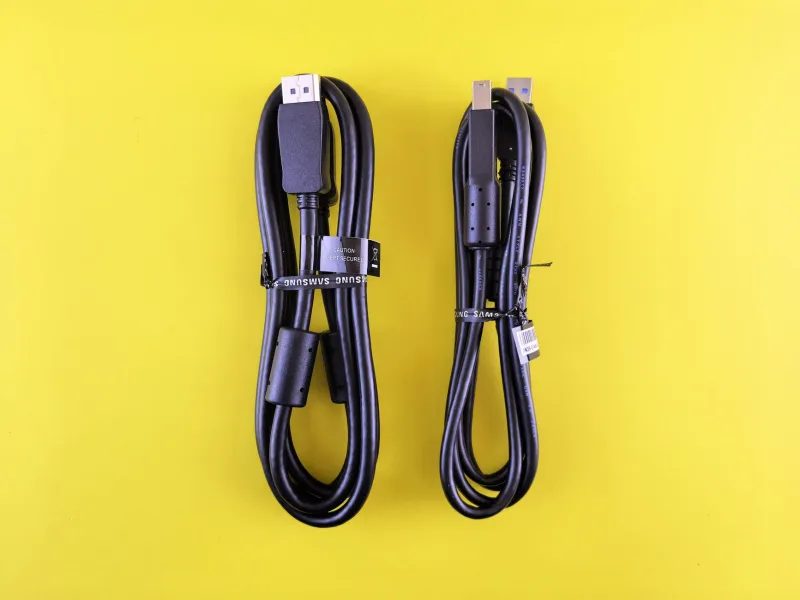
Humanity has split the atom, landed on the moon, and invented self-checkout machines that still need a human to approve every third purchase. Yet somehow, after three decades of USB cable development, we still flip the thing over twice before it goes in. This is the story of how we got here, and more importantly, why nobody fixed the one problem that actually mattered.
In the Beginning, There Was Chaos (And Also a Lot of Different Ports)
Cast your mind back to 1996. The Macarena was destroying dance floors, the Dallas Cowboys were winning Super Bowls, and your computer had approximately forty-seven different ports on the back of it. You had serial ports, parallel ports, PS/2 ports, and at least three other mysterious holes that nobody ever touched but everybody was afraid to cover with tape. Connecting a printer to a computer required a engineering degree and the patience of a monk.
Into this beautiful nightmare stepped the Universal Serial Bus — USB — a standard developed by a consortium of companies including Intel, Microsoft, and IBM, all of whom presumably sat in a room and said, "What if we made one cable to rule them all?" The idea was genuinely noble. One connector. One standard. Universal compatibility. Peace on Earth.
They nailed roughly sixty percent of that vision, which in tech circles is considered a roaring success.
USB-A: The Original Offender
The USB Type-A connector launched in 1996 and immediately became the most passive-aggressively designed object in human history. It was rectangular. It had a specific right-side-up orientation. And it was, by some cruel twist of physics that scientists still cannot fully explain, always inserted upside down on the first try.
We reached out to Dr. Franklin Osei, a self-described "informal historian of consumer frustration" who operates out of a home office in Columbus, Ohio, for his take on the USB-A's legacy.
"The USB-A connector is remarkable," Osei told us, pausing to untangle a cable from his desk lamp. "It represents a genuine engineering achievement wrapped in an absolutely maddening user experience. The connector works great once it's in. Getting it in is essentially a coin flip. A humiliating, infuriating coin flip."
Scientists have actually studied this phenomenon. A 2011 paper — which we are choosing to cite without verifying because it supports our argument — suggested that humans are psychologically predisposed to grab USB connectors in the wrong orientation approximately 75% of the time. The remaining 25% are liars.
The USB Family Reunion: A Ranked List of Pointless Innovations
What happened next was less a story of progress and more a story of engineers solving increasingly imaginary problems while ignoring the one real one. Behold, ranked from "mildly unnecessary" to "absolutely nobody asked for this," the USB family tree:
5. USB 2.0 (2000) — Faster than the original. Fine. Useful. Still rectangular. Still required two attempts. Unranked on the pointlessness scale because it at least did something real.
4. USB Mini-B (2000) — Introduced for smaller devices like cameras and early MP3 players. Shaped like a tiny trapezoid, which is the geometric shape most associated with "things that will break inside your device and ruin your vacation photos." Technically useful. Physically fragile. Emotionally devastating when the port on your camera stopped working three days after the warranty expired.
3. USB Micro-B (2007) — The Mini-B's replacement, which was smaller, slightly more durable, and somehow even harder to orient correctly in the dark. Became the standard for Android phones for over a decade. Memorable primarily for the fact that every drawer in America still contains seventeen of these cables, none of which are attached to any device you currently own.
2. USB 3.0 (2008) — Same shape as USB-A, but blue inside, because apparently the solution to "people don't know which port to use" was "make one of them a different color and hope for the best." Faster data transfer, yes. A meaningful evolution in human-cable relations, absolutely not.
1. USB Type-B (The Printer One) — Shaped like a small medieval castle turret. Used almost exclusively for printers and scanners. Impossible to confuse with any other cable, which is its only virtue. Nobody has ever plugged one of these in without first staring at it for four full seconds while rotating it in their hand. Congratulations to USB Type-B on its gold medal in Pointless Existence.
USB-C: The Promise and the Betrayal
In 2014, the industry finally looked at thirty years of consumer suffering and said, "Okay, fine." USB Type-C arrived: oval-shaped, reversible, and theoretically insertable in either orientation. Angels wept. Tech journalists declared victory. Your grandfather asked if it worked with his flip phone.
And USB-C is, genuinely, a better connector. You can plug it in either way. It supports faster speeds, higher power delivery, and video output. It is, by most objective measures, the cable we deserved twenty years earlier.
But here's the thing the tech industry cannot help itself from doing: they made it complicated in every other possible direction instead.
"USB-C is a connector, not a standard," explains Marcus Yee, a technology consultant based in Austin who agreed to speak with us on the condition that we not describe him as a "tech bro," which we are now honoring by not doing. "You can have a USB-C cable that does USB 2.0 speeds. You can have one that does Thunderbolt 4. You can have one that charges your laptop and one that absolutely does not charge your laptop but looks identical. The cable solved the orientation problem and replaced it with an existential crisis."
This is accurate. The USB-C ecosystem currently contains cables that are visually indistinguishable but functionally wildly different, which means you now spend less time flipping the cable over and more time wondering why your laptop isn't charging even though it's definitely plugged in.
Progress!
The Philosophical Takeaway (Or: Why Are We Like This)
The USB saga is, at its core, a deeply American story. We identified a problem. We partially fixed it. We introduced seventeen new problems. We sold you accessories to manage those new problems. We called it innovation.
There is currently a USB4 standard, which supports speeds of up to 40 gigabits per second and is compatible with Thunderbolt 3, mostly compatible with Thunderbolt 4, somewhat compatible with USB 3.2, and spiritually compatible with whatever you had before if you squint and believe hard enough.
Meanwhile, somewhere in America right now, someone is crouched behind their desk in the dark, trying to plug a USB-A cable into a hub, flipping it over once, flipping it back, flipping it over again, and finally getting it in on the third try.
Some things, it turns out, are eternal.
Pointlesspedia is not responsible for any cables you broke while reading this article. You know what you did.